
EXPERT ADVICE
Questions You Should Ask a Clothier
THE RIGHT QUESTIONS
Before You Invest, Ask.
The word "custom" gets thrown around loosely. It is used to describe everything from true bespoke — a unique pattern drafted from scratch for your body and your body alone — to made-to-measure, which is really a stock pattern nudged at the margins, a size 40 regular with the waist taken in.
The difference is not semantic. You will feel it in the shoulder, where a bespoke jacket sits clean and natural against your body, and in the chest, where a floating canvas molds to you over the years.
You will see it in how the garment drapes, how it ages, how it makes you feel when you walk into a room and do not have to adjust anything. Before you invest your money and your trust in a clothier, ask these five questions. The answers will tell you everything you need to know.
The difference is not semantic. You will feel it in the shoulder, where a bespoke jacket sits clean and natural against your body, and in the chest, where a floating canvas molds to you over the years.
1. Is this true bespoke or made-to-measure?
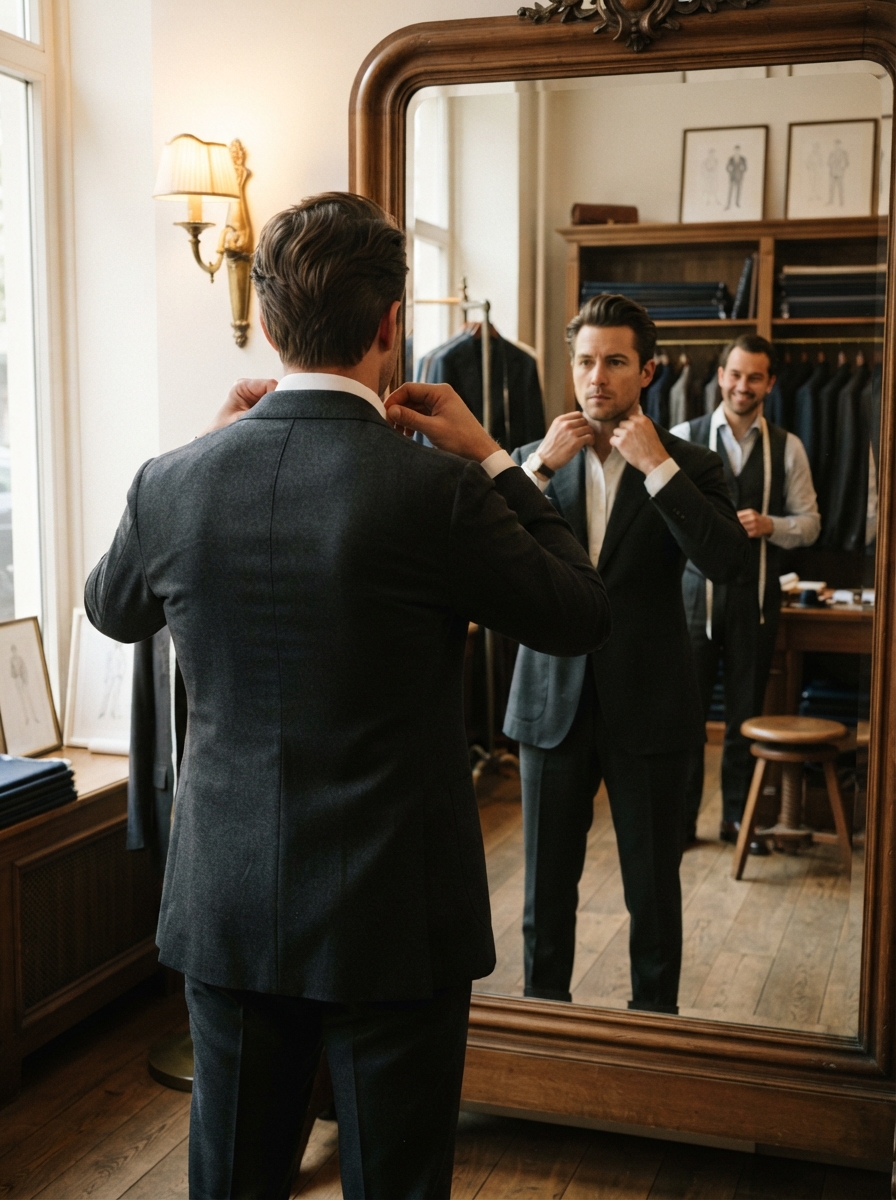
Made-to-measure takes a pre-existing pattern — a stock size, built for a theoretical man who does not exist — and alters it to your measurements. A nip at the waist, a longer sleeve. It is a template adjusted at the edges. True bespoke is something else entirely. It begins with a blank sheet of paper and thirty-odd measurements of your body, and from those numbers a unique pattern is drafted, accounting for your posture, your shoulder slope, the way you stand, the way you move. No two patterns are the same because no two bodies are the same. The difference shows up in the shoulder, where a bespoke jacket sits clean and natural, like it grew there, and in the chest, where the canvas molds to your body over the years until the jacket feels like part of you. Ask the clothier directly: are you creating a pattern specifically for me, or are you adjusting a template? The answer tells you everything.
2. Do you use full canvas construction?
The inside of a jacket is where the real work lives, and where the shortcuts hide. A cheaper suit is "fused" — the front of the jacket is glued to a stiff interlining, like contact paper pressed onto cardboard. It looks fine on day one. Give it two years of dry cleaning and wear, and the glue begins to separate. The chest bubbles. The lapel puckers. The jacket never quite conforms to your body because it cannot — it is held rigid by adhesive. A quality bespoke suit uses a floating canvas, traditionally made of horsehair, hand-stitched into the chest so it moves with you and rolls the lapel naturally. It molds to your body with every wearing. The drape improves with age. The longevity is measured in decades, not seasons. A fused jacket is disposable. A canvassed jacket is an heirloom.
3. Where are your fabrics sourced?
A great suit begins before the first cut — it begins with the sheep, the loom, the mill. A reputable clothier should be able to tell you not just the name of the mill but the story behind it. The wool comes from sheep that graze on alpine grass at four thousand feet in the Piedmont, or from the moors of Yorkshire where the rain makes the fleece dense and soft. The clothier should know what weight is appropriate for your climate — a 9-ounce tropical wool for a August board meeting in Newport Beach is a very different animal from a 16-ounce flannel for a January deposition in Chicago. They should be able to tell you how a particular weave will wear over five years of use, how it will breathe, how it will crease, how it will age.
THE GREAT EUROPEAN MILLS
If the clothier cannot tell you where the fabric comes from, they do not know the fabric. And if they do not know the fabric, they cannot build you a suit worth wearing.

4. How do you handle alterations after delivery?
A bespoke relationship does not end when the suit is delivered. That is when it begins. Your body changes — five pounds after the holidays, a new workout routine, the slow passage of time. Or you wear the jacket for a month and realize the sleeve could be a quarter-inch shorter, the waist could sit a touch trimmer. Ask the clothier: do you handle alterations locally? Are those adjustments included in the initial process? And most importantly — do you use the fitting feedback to refine my pattern for future orders? The right answer is that every fitting makes the next garment better, because the clothier is learning your body and refining the pattern with each commission. The first suit is a draft. The second is a revision. The fifth is a masterpiece. If the clothier treats each order as a one-off transaction, you are not in a relationship. You are at a store.
5. Will you help me build a wardrobe, or just sell me a suit?
A transactional salesperson wants to sell you a suit today and move on to the next man who walks in. A professional clothier wants to understand your career, your social life, your travel habits — the whole shape of your days — so he can build you a wardrobe that works as a system, not a collection of random pieces. He should ask questions about your lifestyle before he ever opens a fabric book. He should know what you already own, what you need next, and what is coming on your calendar. The right clothier is thinking about the navy suit you need for next month's deposition and the tuxedo you will need for the gala in March — and he is making sure both pieces work with the shirts and sport coats you already have hanging in your closet. He is not selling you a garment. He is building you a wardrobe, one piece at a time, over years. That is the difference between a clothier and a salesman, and it is the most important difference of all.
Ready to start the conversation?
Ask us these questions. Ask us any others you can think of. We welcome it. A good clothier is not afraid of scrutiny — he welcomes it, because the questions tell him you are serious about what you wear and why.Sit down with Brad, in your home or your office, and have an honest conversation about what you need and how we can help you build it. No pressure. No obligation. Just two men talking about clothing, and what it can do for the life you live.