The Right Suit for Your Southern California Job Interview
The interview starts before you open your mouth. The panel has already formed an impression the moment you walk through the door, and the suit you are wearing is doing most of that work. For a professional in Orange County or anywhere across Southern California, getting that impression right is not vanity. It is preparation.
Why Fit Is the Only Thing That Matters
There is a particular kind of distraction that a poorly fitted suit creates in a room. Nobody in the interview will say anything about it. Nobody will point to the collar sitting a quarter-inch off your neck or the jacket length that reads as slightly wrong. But they will feel it, and it will register as something they cannot quite name. A suit that fits, by contrast, disappears. The person across the table stops thinking about what you are wearing and starts thinking about what you are saying.
A suit that fits disappears. The person across the table stops thinking about what you are wearing and starts thinking about what you are saying.
This is why fit is the only real variable that matters in interview dressing. Not the brand. Not the price. Not the color, though color matters too. Fit is what separates a suit that helps you from a suit that works against you, and it is the one thing a retail rack cannot give you.
Research consistently identifies fit as the primary reason men are dissatisfied with purchased suits. According to market data, 36 percent of consumers avoid apparel purchases entirely because of inconsistent sizing. For a job interview, that inconsistency is not just frustrating but has professional consequences.
What a Custom Interview Suit Actually Involves
The process of commissioning a custom suit in Southern California does not have to mean scheduling multiple trips to a boutique or navigating a showroom. John Bradley Clothier operates on a fully mobile, appointment-only model. Brad arrives at the client's home or office across Orange County, Los Angeles, and San Diego, bringing everything needed for the consultation: fabric selections from premium mills, measurement tools, and the kind of styling guidance that accounts for the specific role, industry, and occasion.
A typical first appointment runs approximately 45 minutes and covers the full scope of what the suit needs to do. That includes a discussion of the interview context, the employer's culture, the seniority of the role, and how the garment will be used beyond the interview itself. Full body measurements are taken. Fabric and construction preferences are reviewed. The result is a suit built around the client's actual proportions, not approximated from a size pulled from a rack.
The fabrics available through John Bradley Clothier come from the same mills used by the world's leading tailors: Ermenegildo Zegna, Holland & Sherry, Dormeuil, and Vitale Barberis Canonico. These are not names attached to marketing copy. They are the actual supply chain behind the garment, and they determine how the cloth moves, how it holds its shape through a long day, and how it reads at close range.
Choosing the Right Fabric and Color for the Interview
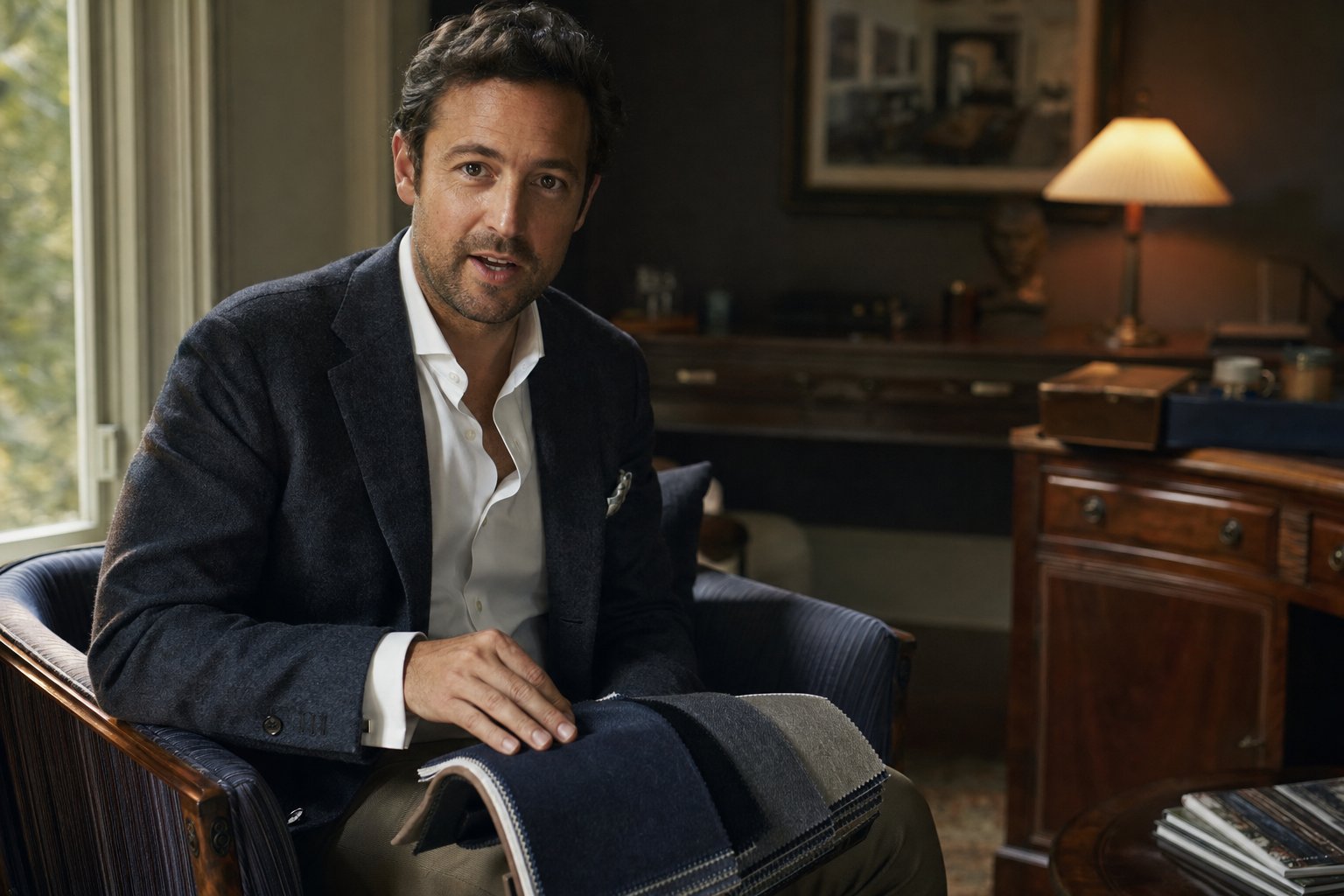
For most professional interviews in Southern California, the most versatile direction is a conservative navy or charcoal suit in a solid or subtly textured cloth. These read as serious without being severe, authoritative without being stiff. The specific choice should account for the company's culture, the seniority of the role, and the climate, which matters more in Southern California than in most markets.
Brad guides clients through this decision rather than simply presenting options. The consultation is not a fabric showroom visit. It is a styling conversation in which the occasion, the audience, and the intended impression all inform the final selection. A navy suit in a lighter Zegna wool that breathes through a warm Orange County afternoon reads differently than a charcoal flannel, and both read differently from a sport coat and tailored trousers. The right answer depends on the room the client is walking into.
The consultation is not a fabric showroom visit. It is a styling conversation in which the occasion, the audience, and the intended impression all inform the final selection.
For clients who want the suit to carry beyond the interview into client meetings, courtroom appearances, board presentations, and business dinners, the fabric and construction choices shift accordingly. A bespoke garment built with that range in mind becomes one of the most durable investments in a professional wardrobe, measured not by price but by the number of high-stakes situations it serves without requiring replacement.
How the Fitting Process Works
A full bespoke commission typically requires two appointments. The first covers measurements, fabric selection, and styling discussion. After the garment is constructed, Brad returns with the first canvas for fitting and addresses any adjustments needed. Additional fittings may be scheduled depending on the complexity of the commission or the precision required.
The entire process happens at the client's location. There is no showroom to visit, no parking structure to navigate, no waiting room. For a professional whose calendar is already full, this is not a minor convenience. It is the difference between the process actually happening and the process being perpetually deferred until the week before the interview.
Kevin, a client who had the process done at his office, described it plainly: "Ease of selecting and being sized for well-constructed, good looking business and casual clothing in the comfort of my office was well worth the investment. Jackets, pants and shirts all are great looking and fit perfectly."
Brian Colvin, another client, put it in terms that speak directly to the interview moment: "Every single time I put on my custom suits, I get compliments. I won't go anywhere else but to Brad Otto, John Bradley Custom Clothier."
The Lead Time Question
One of the most common practical concerns for a professional commissioning a suit ahead of a specific event is lead time. A bespoke garment requires enough time for construction, shipping from the mill, and at least one fitting. The realistic window for a full commission is four to six weeks from the initial appointment, depending on the fabric and the complexity of the order.
This means the time to act is not the week before the interview. It is now, before the timeline tightens and the only available options are the ones that were already available at any department store. For professionals in Orange County and the surrounding area with an important career moment on the horizon, booking a consultation early is the one step that keeps all options open.
For clients who are earlier in the process and simply building out a professional wardrobe rather than preparing for a single event, the timeline pressure is lower and the opportunity is larger. A wardrobe built through a series of appointments with a single trusted clothier, using coordinated fabrics and a consistent fit profile, covers more professional situations with less friction than a closet assembled from multiple retail sources over years.
Frequently Asked Questions
How long does it take to get a custom suit made through John Bradley Clothier? The realistic timeline for a full bespoke commission is four to six weeks from the initial consultation, which accounts for construction and at least one fitting appointment. Clients preparing for a specific interview or event should book as early as possible to keep that window open. Brad serves clients across Orange County, Los Angeles, and San Diego by private appointment at the client's home or office.
Do I need to visit a showroom or boutique? No. John Bradley Clothier operates entirely on a mobile, appointment-only model. Brad arrives at the client's preferred location with fabric books from mills including Ermenegildo Zegna, Holland and Sherry, Dormeuil, and Vitale Barberis Canonico, along with everything needed for measurements and styling consultation. There is no showroom visit required.
What is the difference between a bespoke suit and a made-to-measure suit? A made-to-measure suit starts from a standard pattern that is adjusted to a set of measurements. A bespoke suit is built from a pattern drafted specifically for the client's body, accounting for posture, proportion, and individual fit preferences at a level of precision that made-to-measure cannot match. John Bradley Clothier works at the bespoke level, taking full body measurements and constructing garments to those exact specifications.
Which fabric should I choose for a job interview suit in Southern California? For most professional interviews in the region, a navy or charcoal suit in a mid-weight wool from one of the premium mills Brad carries is the most versatile and authoritative choice. The right fabric also depends on the role, the employer's culture, and the time of year. Brad guides clients through this decision during the consultation, accounting for how the suit will be used beyond the interview itself.
What areas does John Bradley Clothier serve? Brad serves clients throughout Orange County, including Newport Beach, Costa Mesa, Irvine, Coto de Caza, Ladera Ranch, Corona del Mar, and Dana Point, as well as Los Angeles and San Diego. All appointments are conducted at the client's home or office.
The Suit That Earns Its Place
A job interview is one of the highest-stakes rooms a professional enters. The preparation that goes into the presentation, the research, the answers to difficult questions, and the understanding of the company and the role: all of that work deserves to be wearing something that does not undercut it. A suit built around the client's actual proportions, in fabric chosen for the specific occasion, handled by a clothier who comes to the client rather than the other way around, is not an indulgence. It is the most direct investment in the outcome.
For professionals across Southern California with an important career moment ahead, the first step is a conversation.
Schedule your private fitting at your office or home
Research sources1
Live web research informed this article. These are the sources it drew on.