The Bespoke Tailor Who Comes to You in Southern California
You are billing at a rate that makes Saturday afternoon shopping genuinely expensive. You have a board meeting, a deposition, or a client dinner in six weeks, and you know your wardrobe is not where it should be. The question is not whether bespoke is worth it. The question is whether the process is worth the interruption.
It is not an interruption anymore.
What Does 'Bespoke Suit Tailor in Orange County Who Comes to Your Home' Actually Mean?
Bespoke is not a marketing word here. It means a pattern drafted to your specific body measurements, cut from fabric you selected in person, constructed to your specifications, and fitted until it is correct. No standard block. No compromise between your shoulder width and your chest measurement. No alteration that fixes what the original cut broke.
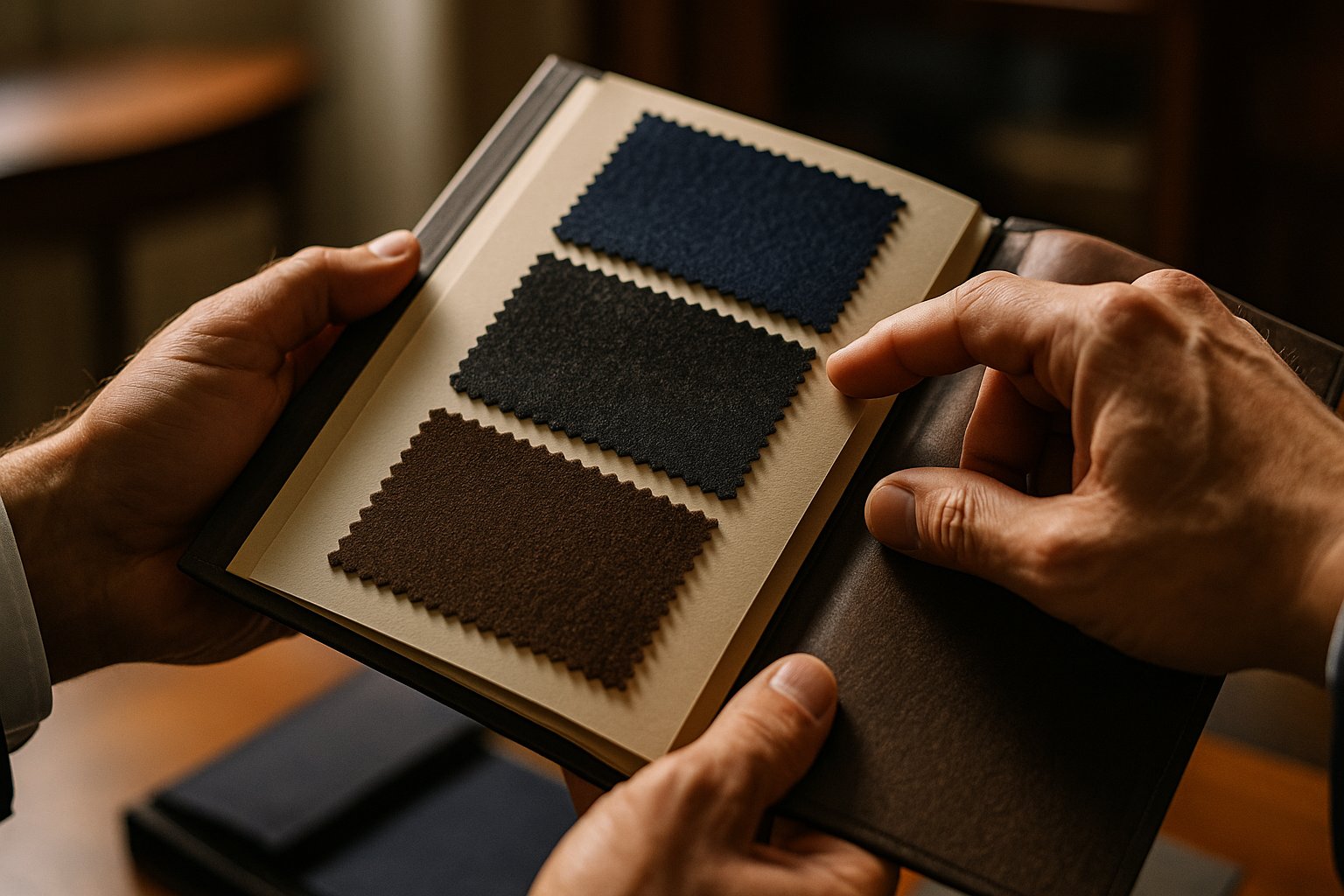
John Bradley Custom Clothier operates as a fully mobile, appointment-only bespoke menswear service across Orange County, Los Angeles, and San Diego. Brad arrives at your home or office with physical swatch books from Ermenegildo Zegna, Holland and Sherry, Dormeuil, and Vitale Barberis Canonico. The same mills supplying the tailors on Savile Row. Takes your measurements in person, guides your fabric and style selections, and manages the entire process from there. You do not go to a showroom. There is no showroom. The fitting room is wherever you are.
The fitting room is wherever you are. Your office, your home, your schedule.
For an attorney in Newport Beach or a financial advisor in Irvine, this is not a luxury add-on. It is the only version of the process that actually fits a working professional's life.
Can You Really Get a Custom Tuxedo in Los Angeles With an In-Home Appointment?
Yes, and this is one of the most common requests Brad handles for Southern California professionals. A black-tie event, a charity gala, a firm anniversary dinner, or a wedding in the family creates the same problem every time: the event is in eight weeks, the calendar is full, and a tuxedo rental or an off-the-shelf option is going to look exactly like what it is.
A custom tuxedo built through John Bradley Clothier begins the same way every other garment does. With Brad at your location, fabric books in hand. You select your cloth, your lapel style, your trouser details. Measurements are taken with the same precision as a full suit commission. The result is a tuxedo that fits your body the way a tuxedo is supposed to fit: clean through the shoulders, structured across the chest, with a trouser break that is exactly where it should be. No guessing. No hoping the rental fits.
The fabric options for black-tie include wool barathea, silk-faced lapel cloths, and evening-weight wools from Dormeuil and Holland and Sherry. Materials that photograph beautifully, hold their shape through a long evening, and signal the kind of quiet confidence that rental fabric simply cannot.
How Is This Different From a Made-to-Measure Suit I Can Order Online?
This is the most important distinction in the custom menswear category, and it is worth being direct about.
Made-to-measure services. Including the well-known online options. Work from a standardized pattern block that is adjusted based on the measurements you submit. You are fitting yourself to a template. The template is then modified slightly. The fabric selection is typically drawn from a house inventory, not a world-class mill. The person reviewing your order has never seen you stand, move, or sit in the garment.
True bespoke is a different discipline. Brad takes your measurements in person, which means he observes how you carry your shoulders, how you stand, whether one hip sits higher than the other, how much room you need through the seat of the trouser when you are seated at a conference table. These are things a measuring tape submitted through a website cannot capture. The pattern is built for you, not adjusted toward you.
The fabric difference is equally concrete. When you select cloth from an Ermenegildo Zegna or Vitale Barberis Canonico swatch book, you are holding the same material used in garments sold at Neiman Marcus for three to four times the price. You feel the weight, the hand, the drape. You make an informed decision. There is no screen between you and the cloth.
One client described the difference simply: the suits he had ordered online needed alterations and still did not look right. When the first John Bradley suit arrived, his wife said it was night and day from anything he had ever worn off a rack.
What Is the Fitting Process Like for a Busy Executive?
The process is designed around one constraint: your time is the most valuable thing in this transaction.
Step one is a consultation appointment at your home or office. Brad arrives with fabric books, measurement tools, and style guidance. You discuss what you need. A trial suit, a wardrobe refresh, a complete professional wardrobe build for a new role. And you select fabrics together. The appointment typically runs forty-five minutes to an hour. You do not prepare anything. You do not need to know the difference between a peak lapel and a notch lapel before Brad arrives. That knowledge is what he brings.
You do not need to know anything about suits walking in. That is exactly what Brad is there for.
Step two is the fitting, which occurs after the garment is constructed to your measurements. Brad returns to your location for this as well. Adjustments are marked and executed. For bespoke garments, this step ensures the pattern is refined before the final pressing and delivery.
Step three is delivery and final review. The garment arrives finished. If any refinement is needed, Brad comes back. The process does not end until the fit is correct.
For professionals who have never worn truly bespoke clothing, the consistent reaction is the same: they did not know a suit could fit this way. Clients report receiving compliments from people who have known them for years. Colleagues who notice something is different before they can identify what it is.
Does a Mobile Tailor Serve All of Southern California?
John Bradley Clothier serves clients across the full Southern California professional corridor. Orange County. Including Newport Beach, Corona del Mar, Costa Mesa, Irvine, Dana Point, Coto de Caza, and Ladera Ranch. Is the primary service area. Los Angeles and San Diego are fully served by appointment.
The mobile model is not a workaround for the absence of a showroom. It is the deliberate architecture of the service. A partner at a law firm in Century City does not need to find parking and navigate a boutique. A real estate principal in Dana Point does not need to block a Saturday. The appointment comes to them. The fabrics come to them. The expertise comes to them.
This model has been operating and growing through referral in Southern California since 2006. The client base is built almost entirely on word of mouth from executives, attorneys, doctors, and financial advisors who found the process and told their colleagues. That is not an accident. It is the natural result of a service that actually solves the problem rather than creating a different one.
What Fabrics Are Used, and Why Does It Matter?
Fabric is where bespoke tailoring either earns its price or fails to justify it. John Bradley sources exclusively from mills whose names are benchmarks in the industry.
Ermenegildo Zegna is an Italian mill whose cloths are recognized by anyone who has bought a suit at the top tier of retail. The weight, the drape, and the way the fabric takes a press are distinctive. Holland and Sherry is a British mill with a heritage that stretches across more than a century of professional suiting. Their wools are the standard reference for English tailoring. Dormeuil produces some of the finest performance suiting wools available, fabrics that hold their structure through a full day of meetings without losing their shape. Vitale Barberis Canonico has been weaving cloth since 1663. Their fabrics carry a provenance that no retail house brand can replicate.
When you hold a swatch from one of these mills, you are holding the same material a tailor on Savile Row would use. The difference is that you are holding it in your own office, in Southern California, with a clothier who has already taken your measurements and is ready to build something specific to your body.
The fabric is not a detail. It is the foundation of why a bespoke suit still looks right in ten years when everything else in the closet has been replaced.
Your Next Step: One Appointment, No Commitment, No Store
Every question this page has answered points to the same conclusion: the bespoke process, done correctly, is not more complicated than buying a suit at a department store. It is simpler. You schedule one appointment. Brad arrives. You make decisions together, in person, with actual fabric in your hands. Everything after that happens without you.
The result is a garment that fits your body, built from cloth that will last, delivered to your door without a single trip to a showroom.
If you are in Orange County, Los Angeles, or San Diego and you are ready to find out what a suit built for your body actually feels like, the next step is straightforward.
Schedule your private fitting. Brad comes to you.